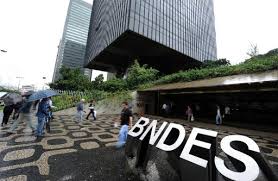
Brazil’s national development bank BNDES has launched new tools to help infrastructure firms absorb the costs of high interest rates, including flexible interest rates, cancellation pre-approval and a financing solution known as a mini-perm.
The tools will be available through traditional financing lines or via the subscription of structured local bonds known as debentures. The aim is to bolster companies’ ability to secure funding, BNDES said in a statement.
“This solution from BNDES is extremely welcome, as it represents cash relief for companies with very long-term financing needs in structuring projects. Companies raising funds at a time like now, when interest rates are very high, need alternatives so they aren’t forced to bear the elevated cost of capital for excessively long periods,” Marco Aurélio de Barcelos Silva, CEO of highway concessionaires association ABCR, told BNamericas.
The highway sector has one of the largest private investment portfolios and is benefitting from an extensive agenda of concessions. But those contracts come with average terms of 30 years, exposing companies to financing risks.
Brazil’s Selic benchmark interest rate is currently at 15%, the highest since 2006, when it stood at 15.25%.
Central bank governor Gabriel Galípolo has said rates will need to remain high for a prolonged period to lower inflation and anchor market expectations.
The country’s official inflation index, IPCA, reached 5.30% in the 12 months through mid-July, up from 5.27% in mid-June. The central bank targets a range of 1.5–4.5%.
A budget of 5 billion (bn) reais (US$930mn) has been earmarked for the flexible interest rate mechanism, designed for sectors with long capex cycles. At the time of disbursement, borrowers may choose between the contractual cost indexed to the long-term rate (TLP) or the prevailing cost indexed to the broad national consumer price index (IPCA), BNDES said.
The pre-approval for cancellation tool allows BNDES to authorize cancellation of a subcredit to enable future bond issuance. From two years after signing the contract, the company may opt to replace all or part of the undisbursed credit with capital market funding, up to 60% of the total financing. The new bond issuance may be anchored by BNDES. This tool has no budget allocation limit and is aimed at the logistics and transport, urban mobility, energy and water sectors.
Unlike the other two tools, the mini-perm solution involves disbursement in the initial project phase. It offers medium-term loans of up to five years for projects with shorter capex cycles. The minimum loan size is 40mn reais and the tool has a total budget allocation of 10bn reais.
BNDES said the new tools are likely to help stimulate capital market financing in the medium term.
“We encourage clients to access the capital markets to refinance the project. We built this incentive into the product. It’s a way for BNDES to fulfill its role of being present at the start of the project, when the risks are higher. By the end of the mini-perm, the project is likely either completed or close to completion. At that stage, the risk is lower and, therefore, the likelihood of accessing the capital markets is greater,” Luciana Costa, BNDES director of infrastructure, energy transition and climate change, said in the statement.
BNDES’ mini-perm product was modeled on international examples, but adapted to Brazil’s local conditions.
“It is a very common product outside Brazil. But abroad, the banks that provide mini-perm loans are willing to take on the refinancing risk. Here, we couldn’t design it with that risk because our capital markets are very volatile. So we provide firm guarantees to ensure funding won’t be lacking for the project until its completion. The BNDES mini-perm is an improvement over the version available in the international market,” Costa said.
Until 2022, BNDES financed infrastructure projects entirely with subsidized funds. That share fell to 10% in 2023. Despite the shift, BNDES’ average annual approvals for infrastructure projects rose from 38bn reais between 2015 and 2022 to 76.5bn reais in 2023 and 2024.
The expansion is the result of innovations in BNDES’ financing mechanisms.
“We have grown significantly through non-recourse project finance [where only future revenues serve as collateral]. In the past, we did everything through [enterprise credit line] Finem. Now we work more with debentures. So we co-invest with the capital markets and the private sector,” said Costa.
link
:max_bytes(150000):strip_icc()/personalfinance_definition_final_0915-Final-977bed881e134785b4e75338d86dd463.jpg "What Is Personal Finance, and Why Is It Important?")