Five-year plan to back AI, advanced industries, low-credit borrowers
Woori Financial Group, one of South Korea’s top financial service providers, plans to put a combined 80 trillion won ($57 billion) into promoting a transition toward productive, inclusive finance over the next five years, the group announced Monday.
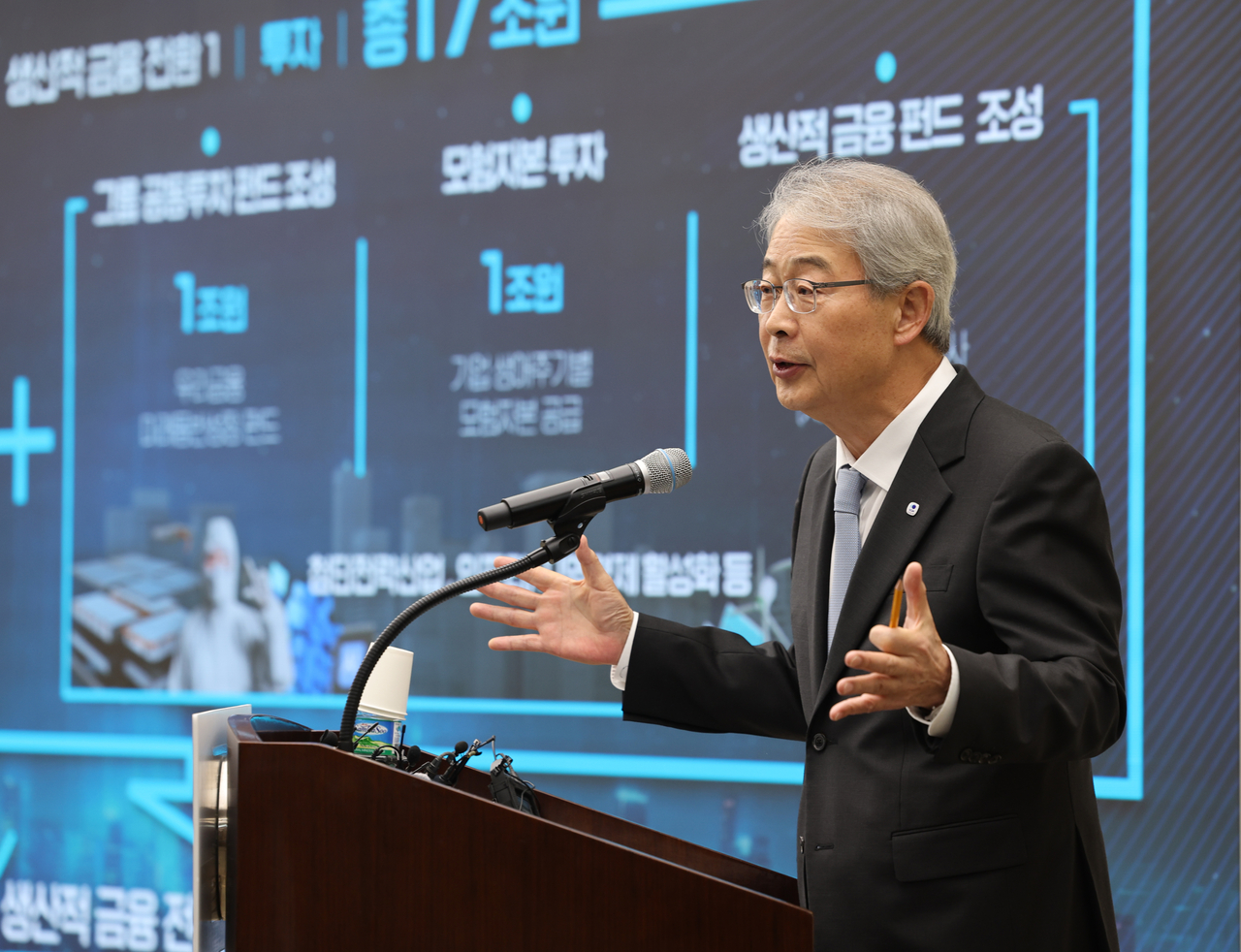
Woori Financial Chair Yim Jong-yong unveiled the so-called “Future Co-Growth Project,” which includes a range of initiatives aimed at supporting shared growth with the public.
“It is a critical time for our economy to find new growth momentum, and the financial sector must play its part. Woori Financial has so far been criticized for relying heavily on mortgage and real estate financing,” Yim said at a briefing held at the group’s headquarters in central Seoul.
“We humbly accept such criticism, and with a sense of urgency, we are pushing forward with this project to shift toward productive finance that supports the growth of companies and society.”
As part of the move, Woori Financial will allocate a total of 80 trillion won over the next five years through 2030. While 73 trillion won has been earmarked for productive finance, the remaining 7 trillion won will be used for inclusive finance.
Of the 73 trillion won, 10 trillion won will be put into the “Public Growth Fund,” one of the key economic pledges made by President Lee Jae Myung.
Earlier this month, Lee announced that Korea will create a 150 trillion-won public-private fund to support investment in artificial intelligence and other advanced industries.
Woori plans to provide another 56 trillion won in loans for small and medium-sized enterprises in advanced strategic industries, innovative ventures, exporters in key national industries, promising small businesses and self-employed merchants.
The remaining 7 trillion won will be put into Woori Financial’s self-led investments.
This will enable Woori to offer more inclusive finance by allowing interest rate cuts for borrowers with low credit ratings and providing guaranteed loans to small business owners and self-employed merchants.
Woori Financial stated that the scheme is designed to benefit the financial service provider by increasing its corporate loan growth up to 10 percent. Expanding corporate lending could reduce the firm’s dependence on real estate loans.
While setting aside 80 trillion won for the project raises concerns about the firm’s capital adequacy, Yim said Woori Financial can maintain stability.
“Even with high risk weights, we are certain that Woori Financial can achieve a Common Equity Tier 1 ratio of 13 percent this year,” Yim said, referring to the CET1 ratio, a key indicator of banks’ capital adequacy. Woori Financial’s CET1 ratio stood at 12.82 percent at the end of June.
“The corporate value-up plan and shareholder return policy will be carried out without deviation,” he said, in efforts to reassure investors.
Meanwhile, other financial service providers, including Hana Financial Group, Shinhan Financial Group, and KB Financial Group, are competitively rolling out initiatives to support SMEs and self-employed merchants in response to the government’s push for responsible growth.
By Im Eun-byel (silverstar@heraldcorp.com)
link
:max_bytes(150000):strip_icc()/personalfinance_definition_final_0915-Final-977bed881e134785b4e75338d86dd463.jpg "What Is Personal Finance, and Why Is It Important?")